
Overview of the Provost’s Showcase
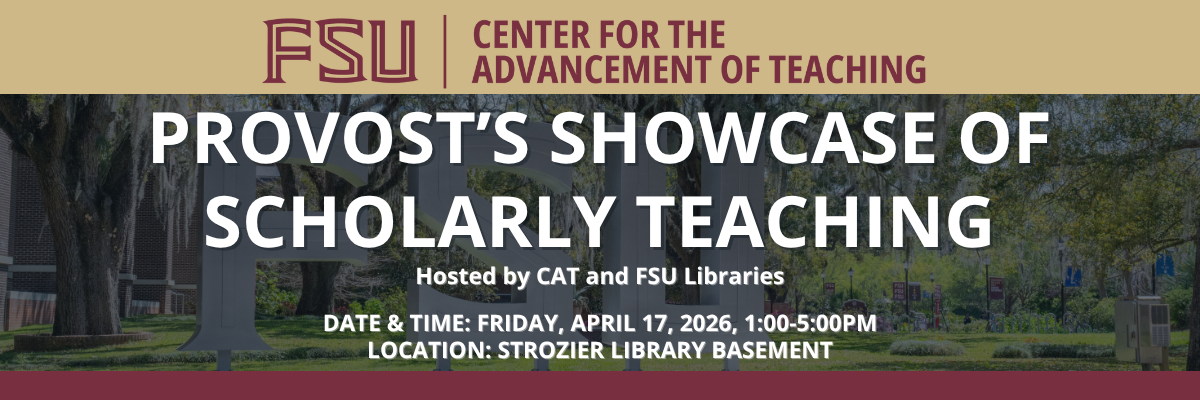
The third annual Provost’s Showcase of Scholarly Teaching (PSST) will be held on Friday, April 17, 2026. CAT, along with FSU Libraries, invites faculty members and graduate teaching assistants from all disciplines to submit proposals for poster presentations and roundtable discussions that advance innovative and effective teaching practices in higher education. We aim to foster a collaborative environment where participants can share evidence-based strategies, explore emerging trends, and address challenges in creating significant learning experiences.
If you have been developing teaching approaches or strategies that you would like to share with the larger campus community, we hope you will submit a proposal for a poster presentation. Or if you have a question—for example, one about teaching effectiveness, student engagement, or recent innovations in teaching—we hope you will consider hosting or attending a roundtable, where you can pose the question and explore possible answers with colleagues.
Even if you’ve never thought about presenting at a pedagogical conference before, you likely have insights worthy of discussion. We encourage you to submit a proposal and attend the showcase. Your proposed project can be in the following categories, though related topics are also encouraged.
- Facilitation of Learning: Strategies for guiding student engagement, such as active learning techniques, collaborative activities, technology-enhanced facilitation, and culturally responsive pedagogy, etc.
- Designing Learning Experiences: Innovative course and curriculum design, including blended/hybrid modalities, universal design for learning (UDL), open educational resources (OER), and integration of emerging technologies like AI or VR…
- Monitoring Students’ Learning: Assessment methods, feedback mechanisms, grading practices, and tools for tracking progress…
- Creating Optimal Conditions for Learning: Building supportive, welcoming environments, barrier removal, holistic student support, and fostering positive class climate…
Logistics
When: Friday, April 17, 2026
- 11:45 am –12:45 pm: Pre-event Social Hour
- 1:00 pm – 5:00 pm: Presentations and Roundtable Discussions
- 1:00 pm – 4:50 pm: Special Resource Tables hosted by Academic Center for Excellence, the team of Academic Honor Policy, Graduate Student Resource Center, and Office of Digital Learning and Academic Technology
Where: Strozier Library Basement (116 Honors Way, Tallahassee, FL 32304)
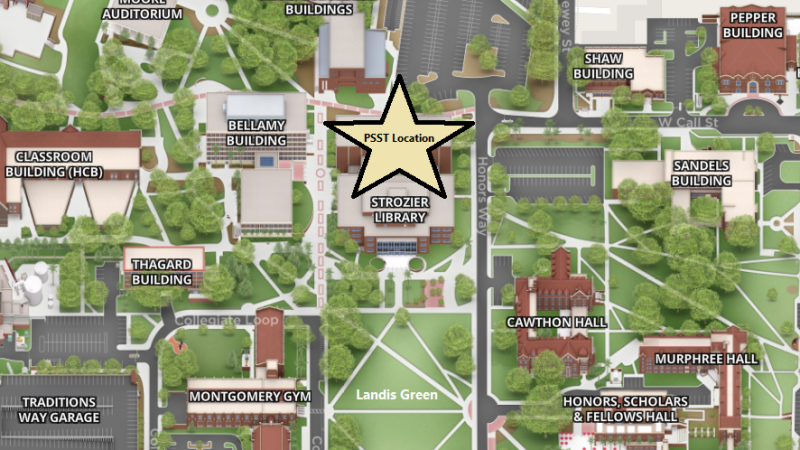
Click here to view a full campus map
Schedule at a Glance
11:45 am – 12:45 pm: PSST Pre-event Social Hour (The Basement of Strozier Library)
12:45 pm – 12:55 pm: Opening Remarks (The Basement) – Joe O’Shea/Jim Clark
1:00 pm – 1:50 pm: Poster Presentation (P1, Designated Area in the Basement)
- P1.1 Jenny Root: Engaging Doctoral Students in the Scholarship of Teaching and Learning
- P1.2 Michele Dames and Heather Bishop: Outcomes‑Driven Program Reflection
- P1.3 Omer Arslan: From an Informal Pedagogical Conversation to Formal Course Redesign: A Faculty-Instructional Technologist Collaboration
- P1.4 Michaé D. Cain, Malaika Samples & Burcu Izci: Immersive Learning: Using Simulation to Increase Students’ Interprofessional Skills and Knowledge in Practice
- P1.5 Peter Marti & Julie Baisden: Bridging Theory and Practice through Virtual Simulation Microteaching
- P1.6 Allison McHugh: Work Readiness: Preparing Nurse Executives for the Real World
- P1.7 Eric Ludwig, Brittany Closson-Pitts, & Ulshat Mussayeva: Alumni Mentorship Programming: Cultivating Opportunities for Collaboration, Community, & Agency
- P1.8 Kadir Kozan and Sewon Joo: Integrating AI into Engineering Education: A Phenomenological Case in the Wild
- P1.9 Sharanya Jayaraman and Christopher Mills: Encouraging Learning, Not Automation: AI Use in Introductory Programming
- P1.10 Samantha Tackett, Selena Ortiz, Lia O’Malley, JJ Jerez, Emma Zolecki: The PRE Program: Maximizing Student Success through Early, Personal, and Systematic Outreach
- P1.11 Katarzyna Pomian Bogdanov, Khadija Zogheib, Patrick O. Sonde, Olayinka Joshua Oyewole, & Sukanya Chakraborty: Teaching Together, Learning Together: A Look into How Faculty and Graduate Students Co‑Design an Elementary Science Methods Course
- P1.12 Elizabeth Hammock: Development of a Tool to Practice Discipline-Specific Thinking
- P1.13 Eric Liguori, Susana Santos, Madison Miller, & Taylor Loope: Pedagogy by Design: Rethinking Entrepreneurship Competitions in Higher Education
- P1.14 Gabrielle Lamura: Trial of Silver Tongues: Gamifying Persuasion through Dungeons & Dragons
- P1.15 Katie Valentine & Garret Hall: “Thank You So Much for Bringing This Up in Class Today!” Finding Connections and Talking about AI in the Classroom
- P1.16 Alaina Young and Brittany Kraft: How Students Use AI in Writing: Perspectives from a Large Lecture Course
2:00 pm – 2:55 pm: Roundtable (R1)
Rotation 1: 2:00 pm–2:25 pm | Break: 2:25 pm–2:30 pm (Participants can move to a different roundtable) | Rotation 2: 2:30 pm–2:55 pm
Bradley Reading Room
- R1.1 Kerry Burner: Embedding Metacognition & Self-Regulated Learning in Course Design
- R1.2 Steven Palazzo: Your Voice Counts – Continuous Student Feedback
- R1.3 Megan Buning, Mason Levasseur, Jennifer Gosline, & Brandon Bradwell: Using DISC Behavior Profiling to Enhance Coaching Students’ Helping Skills
- R1.4 Allan Jeong: Causal Diagrams + AI Feedback: A Cross‑Domain Framework for Critical Thinking and Problem-Solving
- R1.5 Suzy Ji, Audrey Aguiar, & Dr. Justin Hultman: Integrating Research Literacy into Undergraduate Career Development Education
Graduate Instruction Classroom (005A)
- R1.6 Sharanya Jayaraman: Teaching with Guardrails: Using Source-Grounded AI in Introductory STEM Courses
- R1.7 Samantha Tackett: Experiential Classroom Activities that Support Students’ Social, Psychological, and Emotional Development
- R1.8 Eman Vovsi: “Acting in the Past” – Cuban Missile Crisis, 1962: A Simulation Exercise
- R1.9 Emelie Griffin, Renata Schama, Amit Anshumali, & Camilo Rubbini: Rapid Learner Mapping: Scalable Ways to Learn Who Your Students Are in the First Two Weeks
- R1.10 Caroline Laganas: Cooking Up Delectable Classroom Experiences with Universal Design for Learning
3:00 pm – 3:55 pm: Roundtable (R2)
Rotation 1: 3:00 pm–3:25 pm | Break: 3:25 pm–3:30 pm (Participants can move to a different roundtable) | Rotation 2: 3:30 pm–3:55 pm
Bradley Reading Room
- R2.1 Deanna Barath: Teaching with AI: Preparing, Debating, and Reflecting
- R2.2 Susana Santos and Marina Lickson: From Classroom to Community: A High-Impact Service-Learning Model in Entrepreneurship Education for Social Impact
- R2.3 Emil Asanov, Laura Bell, Cigdem Cokay, Zhiying Li, & Mahshid Mahbodi: Reading to Engage and Engaging to Read: How Can We Invite Our Students to Read (for Class)?
- R2.4 Inge Guerrero: What’s Something You Tried in Your Teaching That You Weren’t Sure Would Work, But Ended Up Being Surprisingly Effective?
Graduate Instruction Classroom (005A)
- R2.5 Sunah Lee: Learning with a Big Idea: A Community Engagement Project with a Flipped Classroom Approach
- R2.6 Yixin Qian: Navigating AI in the Classroom: Concerns, Strategies, and Teaching Practices
- R2.7 Jason Pappas and Sachin Narayanan: Standing Out in a Saturated Sports Industry: Teaching Differentiation, Personal Branding, and Competitive Advantage Through Experiential Learning
- R2.8 Bret Staudt Willet: Team Players and Individual Performers: Updating a Vision for and Assessment of Group Projects
4:00 pm – 4:50 pm: Poster Presentation (P2, Designated Area in the Basement)
- P2.1 Vanessa Dennen, Megan Crombie, and Nuodi Zhang: Learning Research Through Partnership
- P2.2 Marlo Ransdell and Lucia Salvato: Making Connections: Applied Math for Designers
- P2.3 Logan Chalfant: Shake, Rattle, Refine: ScooterBots, Teacher Prep., and Engineering Design
- P2.4 Mira Talpau Joos and Tristen Ragsdale: Student Processes and Responses to an AI‑supported Assignment in a Basic French Class
- P2.5 Danielle Porter & Brittany Kraft: Faculty as a Conduit: Centering the Student Across Human and Academic Dimensions of Development.
- P2.6 Mark Melichar: The Country Music Guide to Economics
- P2.7 Angela Sehgal: The Use of Artificial Intelligence (AI) – Quinncia Software in Professional Development of Undergraduate Healthcare Career Students
- P2.8 Dina Vyortkina: Supporting Instructors in Online Teaching
- P2.9 Anel Brandl & Eileen Fancher: Meaning-Based Approaches to Language Teaching: An Implementation in Elementary Spanish
- P2.10 Shatha Alrashdan: Pedagogies of Silence: Monstrosity, Voice, and What Classrooms Make of Us
- P2.11 Aimée Boutin, Jonathan DaSo, Rachel Duke, & Kelly Grove: Teaching Digital Literacy in FRT 3503 “Paris World Capital”
- P2.12 Michaé D. Cain, Malaika Samples, Burcu Izci & Kyle Cook: Evaluating the Integration of Virtual Reality into Social Work Education: Adapting Delivery Methods Based on Course Level
- P2.13 Jessica Smith, Michael Tuttle, & Jenny Root: Empowering Excellence: Elevating Evaluation in Education for Students with Visual Impairments: A Focus on Annual TSVI and COMS Performance Reviews
- P2.14 Bayla Thompson: A Token-Based Extra Credit Model to Promote Autonomy, Flexibility, and Meaningful Engagement for Student-Centered Learning
- P2.15 Yinan Li: Cultivating Collective Self-Care in Graduate Training: An Experiential Internal Family Systems–Informed Approach
4:50 pm – 5:00 pm: Closing Remarks (Bradley Reading Room) – Joe O’Shea/Jim Clark
To view the full program with session descriptions, please click PSST_2026_Program.
Formats
There will be two presentation formats: poster presentations and round-table discussions. You may apply for only one format for each presentation. If you plan to apply for more than one presentation, you need to apply separately.
Poster Sessions
You can design a poster that summarizes the teaching innovation or scholarship that you would like to share. Your poster should include both text and figures (e.g., tables, graphs, diagrams, photographs). You will have time to present your poster and discuss your work with other participants, as well as visit other presenters to learn about their work.
If your own department has poster-printing facilities, you are encouraged to print your poster there. Otherwise, you can print one poster for each presentation of yours (if accepted) at the Digital Studio at FSU, free of charge. When we notify you of acceptance, we will provide further guidelines regarding the size and format of the posters.
Round Table Discussions
In this format you can share something you’ve been working on, get feedback and input from colleagues, and answer their questions about what you’ve been working on and why. You can also use this space to start a conversation about something that intrigues you, such as incorporating AI in teaching, or team-based learning. A roundtable is a particularly great format for starting a discussion about something you want to learn more about.
Roundtable discussions are not presentations; instead, they are very participatory and you can bring questions to engage your audience. Each round table discussion session will last for 50 minutes, but there will be a signal at the 25-minute mark for participants who wish to switch tables.
Eligibility
If you have taught (have been an IOR) at FSU or the FAMU-FSU College of Engineering, you are eligible to apply to present. You may have taught collaboratively, and so you may co-present with a colleague, or include a colleague as a co-author on your poster. Co-presenters and co-authors can be grad students, Learning Assistants, etc. If you have questions about eligibility, please feel free to connect with us via pro-teaching@fsu.edu to check.
Consult with Us
If you’d like to discuss your project or idea for the Provost’s Showcase, or if you would like more guidance on the application process, feel free to contact us at pro-teaching@fsu.edu
Information for Tabling Request
We also welcome offices/units who offer teaching and learning-related services to faculty or students to share information at special tables. If your office/unit would like to promote your services and resources by tabling at the 2026 PSST, please make a request by responding to Questions 1, 5, & 9 in the Application Form.
Application
If you plan to present your teaching, please fill in the 2026 Provost’s Showcase of Scholarly Teaching Application Form. To complete the form, you will need the title and abstract of your proposal. The abstract, 250-300 words, should include the following components: (1) contexts for the innovative teaching or classroom experiences you propose to present or discuss, such as course title, class size, course level, in person or online, (2) goals for the teaching innovation, what you did (or plan to do), (3) the effects (or desired effects) of using the teaching innovation, and (4) if accepted, your plan for how to engage audience. This abstract will be shared in the final program to help participants determine how your session will benefit them.
Application Due Date: Feb 1, 2026 (Application is currently CLOSED.)
Acceptance Notification Date: February 16, 2026
Please click the link below to send in your application:
(or copy/paste this link into your browser URL bar: https://forms.office.com/r/vs02U9AV7S)